
Key Takeaways
- A tankless water heater costs roughly two to three times more to install than a traditional tank, but lasts 15–20 years versus 8–12 and uses noticeably less energy.
- Michigan's cold incoming groundwater — often near 40°F in February — cuts a tankless unit's usable flow rate almost in half compared to its advertised rating, so sizing matters more here than in warmer states.
- Macomb County's moderately hard water means both types need regular maintenance: annual descaling for tankless, yearly tank flushing for conventional units.
- Tank heaters remain the better value for most Warren homes with a working gas line and vent; tankless pays off for high-demand households, tight utility spaces, and owners planning to stay 15+ years.
Tankless vs. Tank Water Heaters: The Short Answer
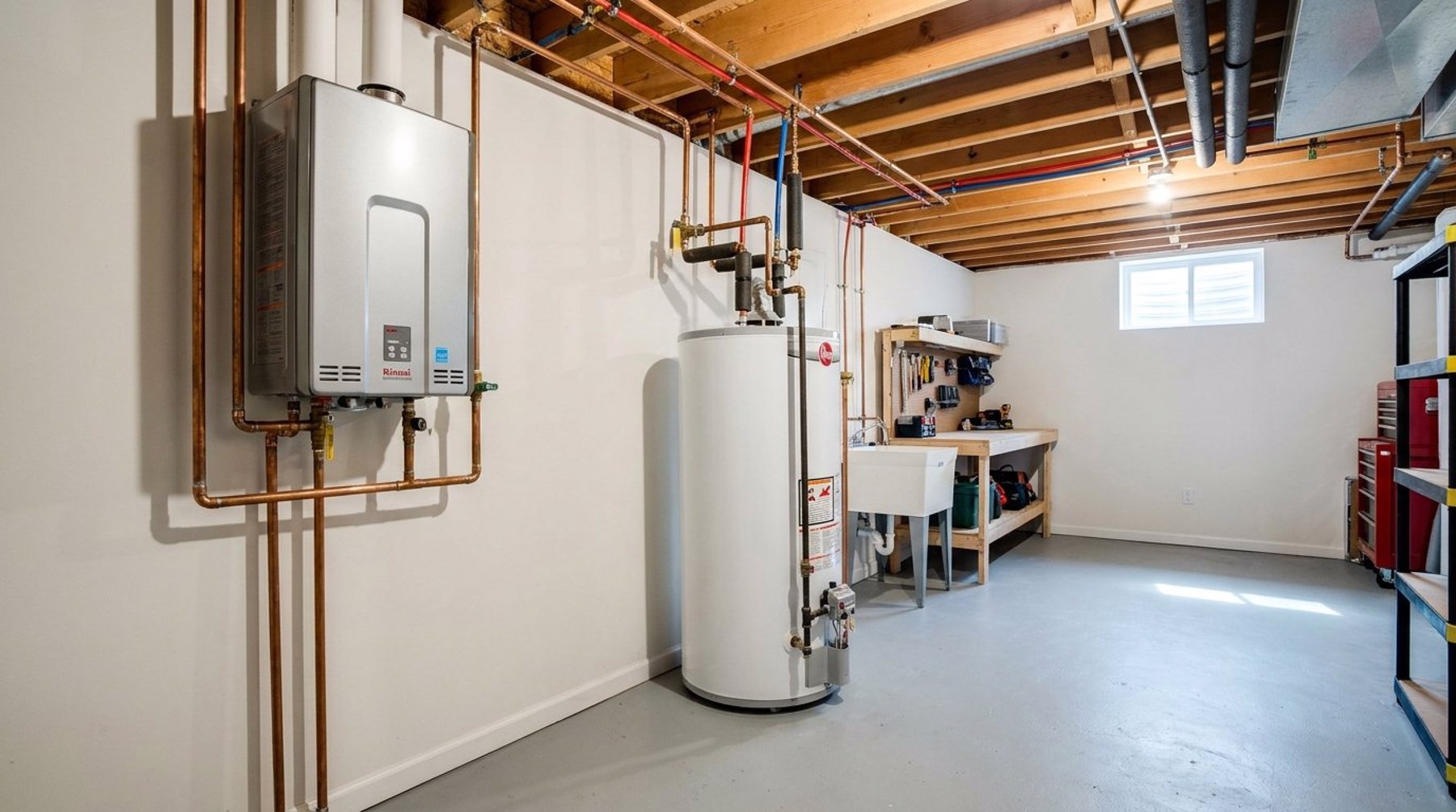
A traditional tank water heater stores 40 to 75 gallons of pre-heated water and keeps it hot around the clock. A tankless unit heats water only when a tap opens, firing a high-output burner to raise the water temperature as it flows through a heat exchanger. Tanks cost less upfront and are simpler to replace. Tankless units cost more, use less fuel, and never run out of hot water.
That summary is accurate but incomplete, because the right choice depends heavily on your house. A 1955 ranch in Warren with a 100-amp service, a half-inch gas line, and a masonry chimney flue is a very different retrofit than a 2015 colonial in Macomb Township already vented through a sidewall.
Water Heater Installation Cost in Warren MI: Tankless vs. Tank
In the Warren and Macomb County market, a standard 40- or 50-gallon gas tank water heater typically runs about $1,500 to $2,800 installed, including removal and disposal of the old unit, new flex connectors, a code-compliant expansion tank, and the permit. A gas tankless installation more often lands between $3,500 and $6,000, and retrofits in older homes can exceed that.
The gap isn't the equipment alone — it's the supporting work a tankless conversion usually triggers:
- Gas line upsizing. A 50-gallon tank burner draws around 40,000 BTU per hour. A whole-home gas tankless draws 150,000 to 199,000 BTU. A half-inch line that fed the old tank fine frequently has to be upsized to three-quarter inch or one inch back toward the meter.
- New venting. Condensing tankless units vent through PVC or polypropylene out a sidewall, not up the existing chimney. If your tank heater shared that chimney with an older furnace, removing it leaves the furnace orphaned on an oversized flue — a real draft and condensation problem that has to be addressed.
- Condensate drainage. Condensing units produce acidic condensate that needs a drain and, often, a neutralizer cartridge.
- Electrical. Even gas tankless units need a dedicated 120V circuit for the controls and fan.
Whole-home electric tankless is usually a non-starter in older Warren and Roseville housing stock. Heating 4 gallons per minute through an 80-degree rise takes roughly 27 kW — about 115 amps at 240V. On a 100-amp service, that means a full panel and service upgrade before the heater is even hung on the wall.
Michigan requires a licensed plumber and a permit for water heater replacement, with an inspection afterward. That is not red tape to route around: an uninspected install can void the manufacturer's warranty and complicate a future home sale.
How Michigan's Cold Groundwater Affects Tankless Performance
This is the single most misunderstood factor in Southeast Michigan, and it's where undersized tankless installations go wrong. A tankless heater's capacity is expressed in gallons per minute at a given temperature rise — how many degrees it can raise the water. Manufacturers advertise the headline number at a small rise, which flatters the unit.
Here, incoming municipal water from the Great Lakes system runs roughly 70°F in late summer but drops toward 40°F by late winter. If you want 120°F at the tap in February, the unit has to deliver an 80-degree rise. A model advertised at "9.8 GPM" at a 35-degree rise will realistically produce closer to 4.5–5 GPM at that 80-degree rise — enough for one shower plus a sink, not two showers and a dishwasher.
Practically, a correctly sized Michigan tankless install means a larger, more expensive unit than the same household would need in Georgia — or two units manifolded together for a busy family bathroom. Any contractor who sizes off the box label without asking about winter groundwater temperature and simultaneous fixture use is setting you up for lukewarm showers in January. When we scope water heater installation jobs, that calculation comes before any equipment recommendation.
Energy Efficiency: What UEF Ratings Actually Mean
Water heaters are rated by Uniform Energy Factor (UEF), the Department of Energy standard that replaced the older Energy Factor metric in 2017. Higher is better, and the number reflects real-world usage patterns rather than lab-perfect conditions.
- Standard atmospheric gas tank: roughly 0.58–0.70 UEF
- Condensing gas tankless: roughly 0.90–0.96 UEF
- Heat pump (hybrid) electric: 3.0–4.0 UEF, because it moves heat rather than generating it
Most of a tankless unit's savings come from eliminating standby loss — the fuel a tank burns all day keeping 50 gallons hot whether anyone uses it or not. For a typical household that translates to something in the range of 20–30% lower water heating fuel use. Real dollar savings depend on your gas rate and how much hot water you actually use; a two-person household that showers once a day saves far less than a family of five.
Don't Overlook Heat Pump Water Heaters
Hybrid heat pump water heaters are the efficiency leader by a wide margin and are often left out of this comparison. They pull heat from surrounding air, so they need about 700–1,000 cubic feet of space — a typical unfinished Warren or Sterling Heights basement qualifies easily. The tradeoffs: slower recovery, audible operation, and they cool and dehumidify the space around them, which is a bonus in a damp Michigan basement come summer. If your existing heater is electric, this is frequently the strongest financial option of the three. Check current DTE Energy and Consumers Energy rebate programs before you buy — utility incentives change year to year.
Maintenance and Lifespan in Macomb County's Hard Water
Water in Warren, Sterling Heights, and much of Macomb County is moderately hard, and mineral content is the main thing that shortens water heater life here. The maintenance requirements differ meaningfully between the two types.
Tank heaters need an annual flush to clear sediment off the bottom of the tank. Skip it and hardened scale insulates the burner from the water, forcing longer burn cycles, producing that telltale rumbling, and stressing the tank's glass lining. The sacrificial anode rod should be inspected every three to five years and replaced when depleted — a $40 part that buys several extra years of tank life and is almost never checked.
Tankless heaters need annual descaling: circulating a food-grade vinegar or descaling solution through the heat exchanger via isolation valves for 45–60 minutes. A tankless heat exchanger has very narrow water passages, so scale that a tank tolerates for years can throttle flow and trigger error codes within two. Insist that isolation valves be installed at the time of the job — without them, every future descale becomes a much bigger labor charge.
Maintained properly, expect 8 to 12 years from a tank and 15 to 20 from a tankless unit; neglected in hard water, both numbers drop sharply. The failure modes differ too: a tank heater usually fails by leaking, which is why it belongs in a pan with a drain, while a tankless unit typically fails by error code — inconvenient, but not a flooded basement.
Which Water Heater Is Right for Your Home?
Here's the decision framework we walk Warren and Clinton Township homeowners through:
- Choose a conventional gas tank if your budget is the primary constraint, your existing venting and gas line work as-is, your hot water demand is moderate, or you may not be in the house another 10 years. It's still the right answer for the majority of replacements.
- Choose gas tankless if you regularly run out of hot water, you want the floor space back in a small utility room, you're already opening walls for a remodel, or you plan to stay long enough to recover the higher install cost through lower bills and a longer service life.
- Choose a heat pump hybrid if your current heater is electric and you have an open basement with reasonable ambient temperatures.
- Decide before it fails. This matters more than which box you pick. When a tank lets go on a Saturday night, you take whatever can be installed today. Planning the swap while the old unit still works is what makes a real comparison possible.
H2O Plumbing handles water heater replacements across Warren, Sterling Heights, St. Clair Shores, and the surrounding Macomb County communities, and we'll give you a straight assessment of what your home's gas, venting, and electrical setup can actually support — including when the cheaper tank is the smarter buy. If your heater is showing its age, get in touch or call (586) 746-8741. If it has already failed and you're standing in water, our 24/7 emergency plumbing team is available any hour.
Frequently Asked Questions
Is a tankless water heater worth it in Michigan?
A tankless water heater is worth it in Michigan for households with high or unpredictable hot water demand who plan to stay in the home 15 or more years. Michigan's cold winter groundwater requires a larger, more expensive unit than warmer climates need, which lengthens the payback period. For moderate-use households with working venting and gas lines, a conventional tank usually delivers better overall value.
How much does water heater installation cost in Warren MI?
In Warren, MI, a standard 40- to 50-gallon gas tank water heater typically costs $1,500 to $2,800 installed, including old unit removal, an expansion tank, and the permit. Gas tankless installation generally runs $3,500 to $6,000 because it often requires gas line upsizing, new sidewall venting, and a condensate drain. Final pricing depends on your home's existing gas, vent, and electrical configuration.
Do tankless water heaters really never run out of hot water?
Tankless water heaters provide unlimited hot water duration, but not unlimited flow. They can supply hot water indefinitely at their rated gallons-per-minute capacity, so a long shower never runs cold. However, if too many fixtures run at once — especially in winter when the required temperature rise is highest — the unit reduces outlet temperature to keep up. Correct sizing for winter conditions prevents this.
How often does a tankless water heater need to be descaled?
Tankless water heaters should be descaled once a year in Macomb County's moderately hard water, and every six months in homes with especially high mineral content or heavy usage. Descaling circulates a descaling solution through the heat exchanger for about an hour using isolation valves. Skipping it restricts the narrow internal passages, reduces flow, and can trigger error codes or void warranty coverage.
Do I need a permit to replace a water heater in Michigan?
Yes. Michigan requires a permit and a licensed plumber for water heater replacement, followed by a municipal inspection. The inspection verifies proper venting, gas connections, temperature and pressure relief valve discharge, and expansion tank installation. Unpermitted work can void the manufacturer's warranty, create safety hazards from improper combustion venting, and cause problems during a home sale.